
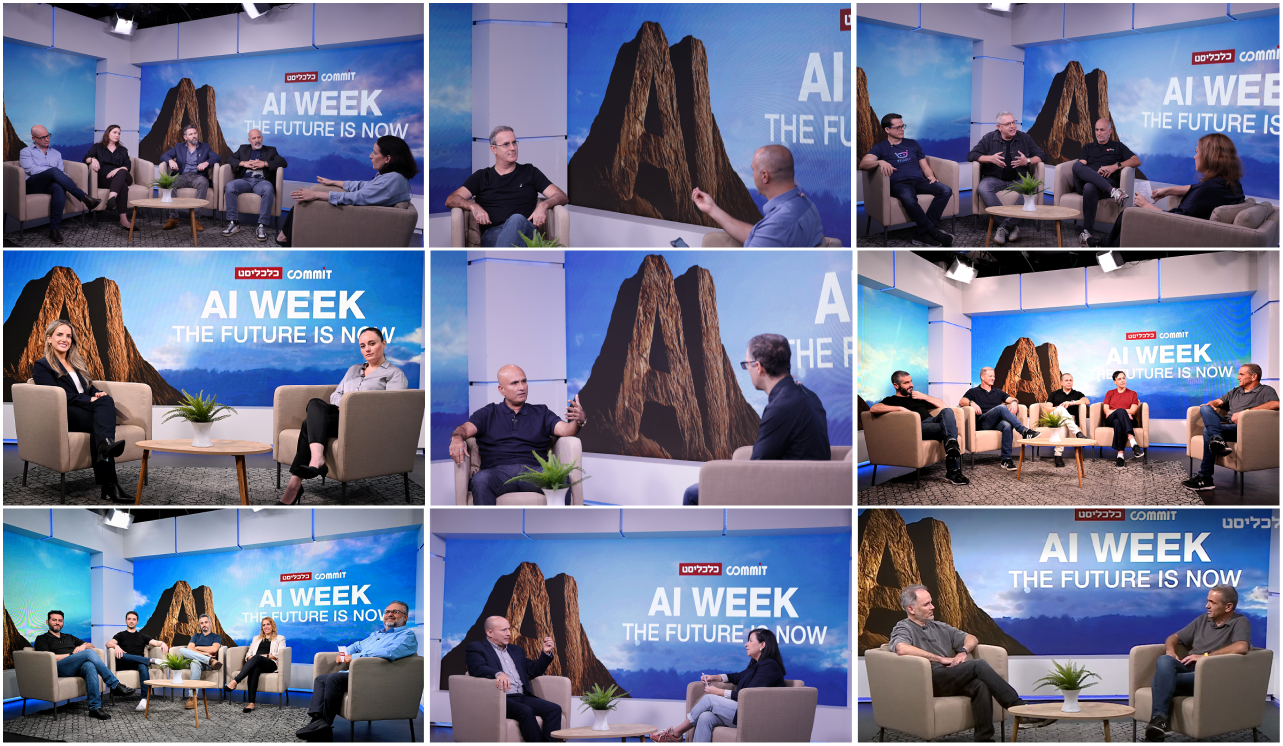
AI Week by Commit and Calcalist brought together senior executives, policymakers, security leaders, and innovators from Israel and around the world for a landmark week of conversations about the future of artificial intelligence. Across ten high-impact sessions, one message was consistent. AI is no longer a concept to explore in isolation. It is a defining force reshaping national strategy, enterprise operations, cybersecurity, and the global economy.
This summary brings together the essential insights that emerged throughout the week.
AI as a National Imperative
Kicking off AI Week, former Prime Minister Naftali Bennett presented a strategic and ambitious national AI vision. He argued that AI represents a once-in-a-century inflection point. Israel must position itself among the top three AI powers by 2030 and focus on areas where Israeli innovation thrives, particularly AI-driven applications rather than foundational model training. Education, defense, and national preparedness are at the core of this plan. He also highlighted the growing threat of deepfakes and the need for new election safeguards in the AI era.
AI’s Rapid Evolution and the Urgency for Action
Arik Faingold, Chairman of Commit and founder of Pentera and Autonomy AI, emphasized that the pace of AI adoption exceeds any previous technological shift. What took the Industrial Revolution two centuries is unfolding in half a generation. From Nvidia GPUs to LLMs and now Agents, the acceleration is rewriting business dynamics. Faingold outlined the emergence of a ten trillion dollar market and stressed that organizations must act quickly, build AI at the core, and cultivate creativity, curiosity, and interdisciplinary thinking.
AI Becomes the Operational Layer
A session led by Microsoft executives and industry leaders from NVIDIA, Bank Leumi, and Palantir underscored a transformative shift. AI is maturing into a context-aware decision-making partner. AI Agents are entering core workflows in pharma, manufacturing, banking, and customer operations. Two themes emerged. First, every employee will soon work alongside an Agent. Second, none of this is possible without unified and well-governed data foundations. Bank Leumi’s experience showed that cultural redesign is as critical as technology in enabling adoption at scale.
AI Adoption: From Hype to Measurable Impact
Executives from Wix, monday.com, Team8, and Autonomy AI shared what it takes to turn AI from buzzword to operational value. Adoption begins with leadership and mindset. Organizations must invest in training teams on how to think in an AI environment, not just how to use specific tools. monday.com’s decision to pause work for a full AI Month demonstrated the level of commitment required. Three pillars were highlighted. The mindset shift. Strategic focus on high ROI use cases. And the acceptance that AI will make mistakes. AI must be treated like a junior developer that learns through iteration.
Turning AI into Real Business Outcomes
Commit’s VP of Product and AI, Nogah Miloslavsky Hendler, argued for a disciplined, metrics-first approach. Each AI use case must be tied to clear KPIs, linking the cost of implementation to expected savings and efficiency. This clarity reduces organizational anxiety and ensures that AI initiatives drive measurable business value. Executive sponsorship is essential. Without leadership alignment, organizations risk remaining stuck in experimentation while competitors move ahead.
Surviving the AI Market Shakeout
Micha Kaufman, Founder and CEO of Fiverr, offered a candid view of today’s AI boom. The market resembles a gold rush, with companies racing to brand themselves around AI without building real defensibility. He stressed that while a bubble is forming, the outcome will differ from the dot-com crash because AI is becoming core infrastructure. Long-term winners will be those delivering differentiated, data-driven value and scaling with discipline. The ability to act decisively and manage risk intelligently is becoming a competitive advantage.
The Global AI Landscape and Israel’s Role
Raj Verma, CEO of SingleStore, echoed this sentiment. AI will reshape civilization more profoundly than previous technological revolutions, yet only a minority of companies will survive the consolidation ahead. He highlighted Israel as a strategic AI hub and noted that Israeli companies are among the fastest adopters globally. With up to nine percent of SingleStore’s revenue already originating from Israel, he sees the local ecosystem as one of the most influential in shaping the global AI future.
Why Most Enterprise AI Projects Fail
AWS’s Boaz Ziniman addressed one of the most pressing adoption challenges. While ninety-five percent of corporate employees already use AI tools, between fifty and eighty percent of enterprise AI initiatives never reach production. The barrier is not experimentation but operationalization. Success requires mature data foundations, governance, and executive sponsorship. Case studies from Stampli and HiBob demonstrated that combining leadership-driven initiatives with bottom-up innovation can achieve organizational-wide adoption.
AI and Cybersecurity: A New Battlefield
Several sessions focused on the rising cyber risks created by AI. Leaders from At Bay, Google Cloud, Commit, and Coralogix explained how phishing attacks have evolved into highly personalized and convincing threats that bypass traditional defenses. The agent ecosystem is becoming the new attack surface, with agents connecting to core systems without sufficient oversight. AI is accelerating both attackers and defenders. Organizations must transition to Secure by Design AI and treat AI security as a strategic priority.
The Dawn of the First AI-Enabled Cyber War
One of the most sobering discussions came from Yossi Karadi, Head of the Israel National Cyber Directorate. He described a scenario in which AI-driven cyberattacks could impose a full digital siege on a nation without a single shot being fired. Critical infrastructure, financial systems, and healthcare could be disrupted simultaneously. The convergence of AI and cyber is already happening across three layers. AI-enhanced defense. Securing AI systems themselves. And the rise of AI agents that attack and defend autonomously. Nations that elevate AI security to the forefront will be more resilient in the conflicts of the near future.
Conclusion
Across all ten sessions, AI Week by Commit and Calcalist revealed a consistent narrative. AI is no longer a future technology. It is becoming the strategic engine of national competitiveness, enterprise transformation, and organizational productivity. The leaders who thrive in this new era will be those who invest early in data foundations, operational readiness, cultural transformation, and security by design.
The AI revolution is here, unfolding within years rather than decades. Organizations that align leadership, governance, and innovation today will define the market of tomorrow.